
Posted on : September 21st 2023

As the digital landscape evolves, so do the tools and techniques used to manipulate images. From selective cropping to sophisticated retouching, the potential for deception is greater than ever before. It is crucial for researchers, authors, reviewers, and publishers to be aware of the implications and take proactive measures to detect and prevent image manipulation.
The Impact of Image Manipulation on Scholarly Publications:
Maintaining the integrity of information is crucial for advancing knowledge and fostering trust within the academic community. However, the increasing prevalence of image manipulation poses significant challenges to the credibility of research findings. Image manipulation encompasses a wide range of techniques employed to fabricate images, often with the intention of misleading or deceiving readers. Image manipulation can take several forms, including but not limited to:
- Data Fabrication: This involves the creation or alteration of data within an image to support a particular research claim.
- Selective Cropping: In this form of manipulation, specific portions of an image are cropped or omitted to present a biased perspective or alter the context in which the image is presented.
- Retouching and Enhancement: This refers to the digital alteration of image attributes, such as color, contrast, or sharpness, to enhance or manipulate the visual appearance of the subject.
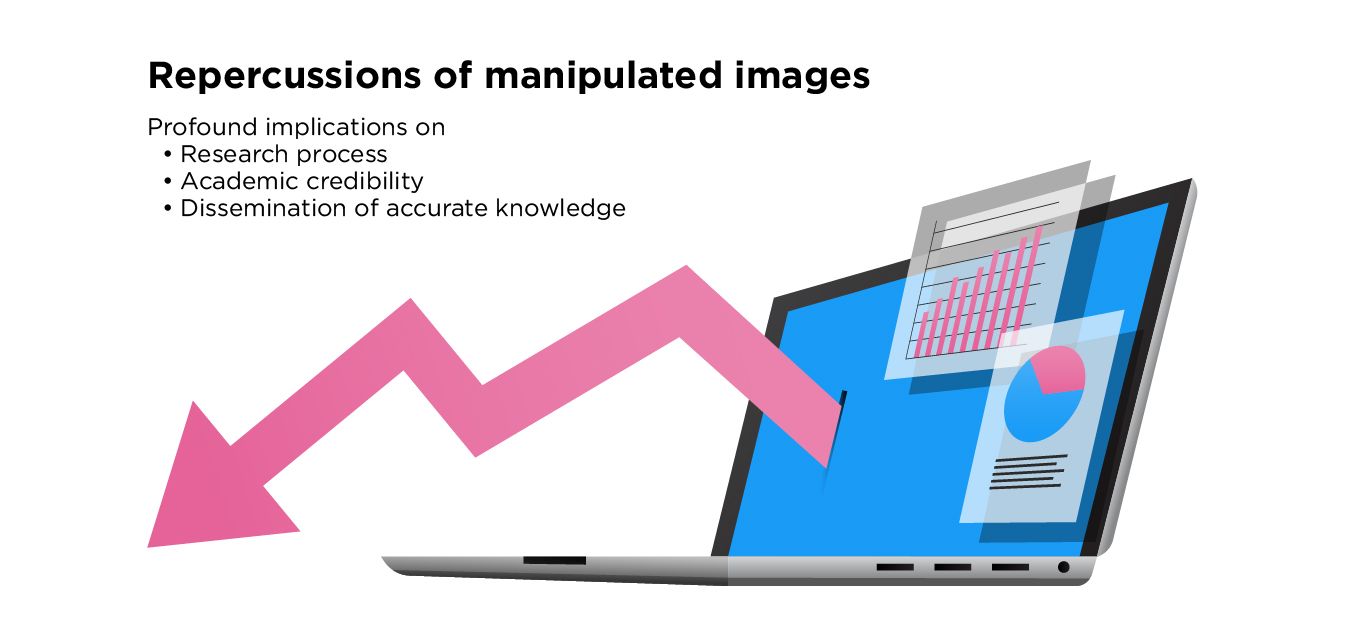
The repercussions of manipulated images in scholarly publications extend beyond mere visual deception. They can have profound implications for the research process, academic credibility, and the dissemination of accurate knowledge. Some potential consequences include:
- Distorted Findings: Manipulated images can distort research findings, leading to false or misleading evidence. This compromises the interpretation of experimental results, potentially impacting subsequent research and conclusions.
- Compromised Research Integrity: Image manipulation undermines the principles of research integrity, including transparency, objectivity, and reproducibility. It erodes trust among researchers and the academic community.
- Misinformation and Misinterpretation: Manipulated images contribute to the spread of misinformation and misinterpretation. They can mislead other researchers, influence decision-making, and lead to wasteful or harmful endeavors based on erroneous information.
- Damage to Reputation and Trust: Scholars and institutions face reputational damage if their published works contain manipulated images. This affects credibility, collaborations, and future research opportunities.
Addressing the impact of image manipulation in scholarly publications is crucial for upholding the principles of academic integrity, fostering a culture of transparency, and ensuring the accurate dissemination of knowledge.
Challenges in Detecting Image Manipulation:
Detecting image manipulation in scholarly publications presents unique challenges that require careful consideration. The sheer volume of published content, the limitations of manual detection, and the lack of standardized detection tools and guidelines specific to the scholarly information industry contribute to the complexity of the task.
- The sheer volume of published content: With the increasing number of published papers, it is difficult to manually scrutinize every image in every paper.
- Limitations of manual detection: Visual scrutiny is currently the standard for analyzing images in scientific papers, but it is time-consuming and prone to errors.
- Lack of standardized image manipulation detection tools: There is currently no standardized method or tool for detecting image manipulation in scholarly publications. Many of the available tools are experimental and not user-friendly.
- Guidelines specific to the scholarly information industry: There is a lack of guidelines specific to the scholarly information industry for detecting image manipulation.
Despite numerous efforts, there is currently no suitable method for the automated detection of image alteration. However, efforts are ongoing to achieve such a solution. In a recent study, researchers developed a software pipeline to detect some of the most common image manipulation techniques. While their approach suffers from a few limitations in scope, it was able to detect image manipulations in a small percentage of published papers.
Technological Advancements in Image Manipulation Detection:

Technological advancements have played a crucial role in developing tools and techniques specifically designed for image analysis and manipulation detection. Two notable approaches that have shown promise in this field are digital forensics tools for image analysis and machine learning techniques.
Digital Forensics Tools for Image Analysis:
Digital forensics tools have evolved to meet the unique challenges of image manipulation detection in scholarly publications. These tools employ sophisticated algorithms and techniques to analyze various aspects of images and identify potential signs of manipulation. Some key capabilities of these tools include:
- Metadata Analysis: Digital forensics tools analyze image metadata, revealing information about origin, modification history, and authenticity. Inconsistencies in metadata can indicate manipulation.
- Comparison Algorithms: Advanced algorithms compare images against known datasets or within the same publication, identifying potential manipulations like duplications, alterations, or partial image reuse.
- Pixel-Level Analysis: Digital forensics tools scrutinize individual pixels for anomalies or irregularities, such as inconsistent noise patterns or unnatural alterations, signaling potential manipulation.
Digital forensics tools offer automation, efficiency, and enhanced accuracy in the detection process. They streamline the analysis of a large number of images, reduce reliance on subjective human judgment, and provide a comprehensive assessment of image integrity.
Machine Learning Approaches:
Machine learning techniques have shown great promise in the field of image manipulation detection. By training models on vast amounts of data, machine learning algorithms can learn patterns and characteristics indicative of manipulation. Key aspects of the machine learning approach in image manipulation detection include:
- Training Data: Algorithms need large datasets of manipulated and non-manipulated images to learn the features and patterns associated with manipulation.
- Feature Extraction: Algorithms extract meaningful features from images, such as statistical properties, texture analysis, frequency domain analysis, or deep learning-based features from convolutional neural networks, to reveal manipulation.
- Classification and Anomaly Detection: Trained models classify images as manipulated or non-manipulated based on learned features. They can also detect anomalies and outliers that deviate from expected patterns, aiding in identifying potential manipulations.
Machine learning approaches offer the potential for automated and scalable image manipulation detection. Once trained, these algorithms can quickly process large volumes of images, making them valuable tools in the fight against manipulation.
It is important to note that while digital forensics tools and machine learning approaches offer significant advancements in image manipulation detection, they should not be seen as a standalone solution. They should complement the expertise and critical thinking of researchers, authors, reviewers, and publishers. Human involvement remains crucial in interpreting the results provided by these tools and making informed decisions regarding the integrity of images.
Collaborative Efforts and Best Practices
Detecting and preventing image manipulation requires collaborative efforts and the adoption of best practices across the industry. These collective efforts foster transparency, trust, and integrity in scholarly publications, ensuring that research findings are reliable and contribute to the advancement of knowledge.
Industry Collaboration:
Addressing the challenges of image manipulation necessitates collaboration among researchers, authors, reviewers, publishers, and technology providers. By joining forces, stakeholders can share knowledge, resources, and experiences to develop effective strategies and tools for detection and prevention. Some examples of industry collaboration include:
- Sharing Best Practices: Establishing platforms or forums for sharing insights and techniques in image manipulation detection promotes consistent standards and enhances image integrity efforts across the scholarly information industry.
- Standardization: Collaborative efforts should focus on establishing standardized guidelines, protocols, and benchmarks for image manipulation detection. This ensures consistent practices among all stakeholders, facilitating the identification and prevention of manipulation.
- Research and Development: Encouraging collaborative research and development initiatives fosters innovation in image manipulation detection. By bringing together experts from different disciplines, new techniques, algorithms, and tools can be developed to combat evolving manipulation methods.
Ethical Considerations:
Ethics play a critical role in the detection and prevention of image manipulation. Adhering to ethical guidelines ensures that scholarly publications maintain integrity and trust. Some ethical considerations to keep in mind include:
- Informed Consent: Researchers and authors must obtain informed consent from individuals whose images are used in scholarly publications. This ensures that images are used appropriately and transparently, without the risk of manipulation or misrepresentation.
- Disclosure and Transparency: Authors should transparently disclose any image manipulation techniques employed, such as retouching or cropping. Clear communication about alterations ensures transparency in the presentation of research findings.
- Responsible Use of Technology: Technology providers and users should ethically evaluate the implications of image manipulation detection tools. These tools should be used responsibly, aligning with ethical guidelines to protect privacy, confidentiality, and the rights of individuals involved.
- Education and Awareness: Promoting education and awareness about image manipulation and its consequences is crucial. By fostering a culture of integrity and ethical conduct, stakeholders can make informed decisions and actively work towards preventing manipulation in scholarly publications.
By fostering collaboration and adhering to ethical considerations, stakeholders in the scholarly information industry can work together to maintain image integrity and uphold the credibility of scholarly publications.
Conclusion
Detecting and preventing image manipulation in the scholarly information industry requires collaboration, technological advancements, and ethical considerations. By establishing standards, sharing knowledge, and leveraging tools like digital forensics and machine learning, we can enhance detection accuracy. Promoting awareness, education, and best practices ensures image integrity and research credibility.
Download our whitepaper to learn more about combating image manipulation and preserving the trust of readers and the scientific community.